

Harriet Tubman:
The Courage
to Return
The remarkable true story of a woman who escaped slavery, then risked her own freedom to help others find theirs.

Some of history's most extraordinary stories belong to people who actually lived them.
Meet Araminta "Minty" Ross, better known to the world as Harriet Tubman. Born into slavery in Maryland, she endured separation, violence, and extraordinary hardship before securing her own freedom in 1849.
But escaping was only the beginning. What makes Tubman's story so extraordinary is what she chose to do afterward: return to the very place she had escaped, again and again, to help others reach freedom.
Before Harriet Tubman, there was Minty Ross.
Araminta Ross was born around 1822 in Dorchester County, on Maryland's Eastern Shore. Her parents, Harriet "Rit" Green and Ben Ross, were enslaved, and the institution of slavery shaped nearly every aspect of her childhood. Even her birth date cannot be established with certainty; enslaved children's births were often poorly documented.
Known as Minty to her family, she was hired out to work for other households when she was still a very young child. This meant long periods away from her mother, difficult labor, and vulnerability to abuse. Three of her older sisters were sold away from the family into the Deep South, a separation that was never repaired.
As a young person, Tubman suffered a devastating head injury after refusing to assist an overseer in stopping another enslaved person. The overseer threw a heavy metal weight at the man, but it struck Tubman instead. She survived, although the injury caused serious symptoms that affected her throughout her life, including episodes of sudden sleep or altered consciousness.
Those experiences did not define the limits of her life. Working alongside her father and others in Maryland's forests, waterways, and marshlands, she developed knowledge of the landscape and its people. Those skills later became essential to her work helping people escape slavery.
In 1849, she made her escape.
By 1849, Tubman faced the possibility of being sold farther south, away from the family and community she loved. The threat was not theoretical. She had already seen what forced separation could do to a family.
She first attempted to escape with two of her brothers, but they turned back. Tubman later set out on her own, traveling through Maryland and Delaware before reaching Pennsylvania. She eventually arrived in Philadelphia, where she connected with members of the abolitionist community.
At approximately 27 years old, she had successfully freed herself. But her family and friends remained behind, and the freedom she had gained was complicated by their absence.
"But I was free, and they should be free."Harriet Tubman, recollecting her family in Maryland
Freedom was not something she intended to keep to herself.
Between roughly 1850 and 1860, Harriet Tubman returned to Maryland approximately 13 times. On those journeys, she helped guide around 70 people out of slavery, including brothers, relatives, friends, and other members of her community.
These were not simple journeys from one place to another. Every person escaping slavery faced serious dangers: capture, betrayal, harsh punishment, and separation from loved ones. Tubman also risked losing the freedom she had already secured.
She relied on her knowledge of the natural environment, carefully chosen routes, trusted contacts, and the support of abolitionist networks. The forests, rivers, and marshes of Maryland were familiar territory, but familiarity did not make those journeys safe. Planning, discretion, and the decisions made by the freedom seekers themselves were all essential.
In 1850, the Fugitive Slave Act intensified the danger. The law strengthened efforts to capture people who had escaped slavery, even in Northern states. Canada became an important destination for many freedom seekers, including people assisted by Tubman.
In 1857, Tubman also helped bring her aging parents out of Maryland. Both had already obtained their legal freedom, but threats against her father made remaining there increasingly dangerous.
A journey through the years
Born enslaved on Maryland's Eastern Shore, in Dorchester County.
Tubman reaches Pennsylvania and eventually Philadelphia after leaving Maryland.
Approximately 13 rescue expeditions lead around 70 people to freedom.
Tubman helps her elderly parents relocate when their safety is threatened.
What was the Underground Railroad?
Despite its name, the Underground Railroad was not a physical railroad, and it did not run underground. It was a network of people, safe locations, and routes that helped enslaved people escape to freedom. Black communities and abolitionists played central roles in organizing and sustaining this resistance.
Why was Harriet Tubman called "Moses"?
Tubman's extraordinary work earned her the nickname "Moses," a reference to the biblical figure who led people out of bondage. Her reputation grew among abolitionists, but much of her work depended on secrecy and trusted relationships.
Estimates of her accomplishments vary because clandestine rescue efforts were not comprehensively documented. Historians generally credit her with personally guiding approximately 70 people to freedom. She also provided advice and instructions that helped dozens of others escape independently.
The numbers are remarkable. Yet the significance of those journeys goes beyond a statistic. Each person had a life, a family, and a future at stake. Each successful escape represented an act of self-determination against a system built to deny it.
Some stories deserve to be carried forward.
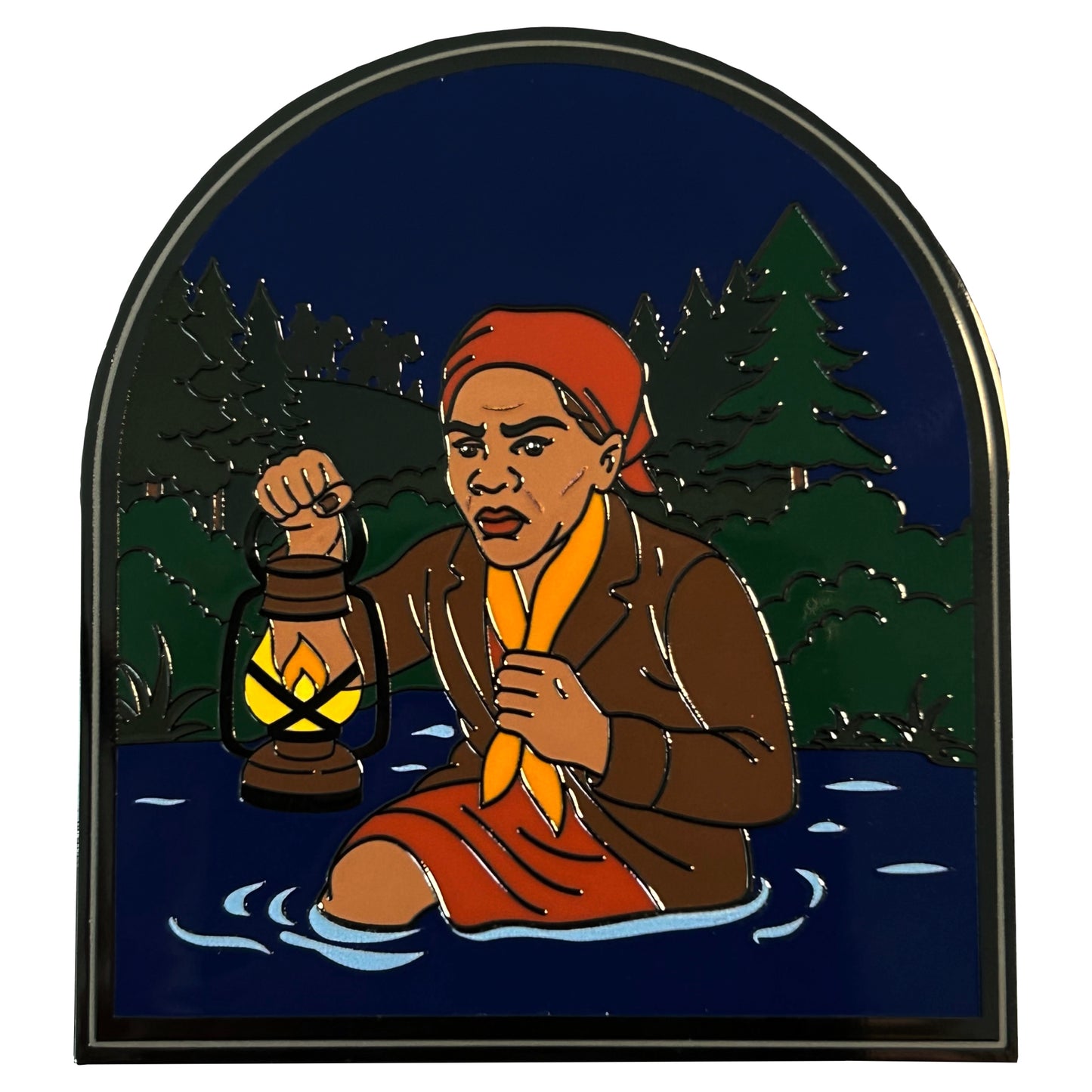
We created our Harriet Tubman pin as a tribute to her courage and to the people whose freedom she helped secure. Our artwork imagines Tubman traveling through the darkness and marshlands, drawing inspiration from the landscape she knew and the dangerous journeys she undertook.
It is an artistic interpretation, not a depiction of one specific documented rescue. No illustration or pin could fully represent the reality of these experiences. But a small piece of art can become a reason to pause, ask questions, and learn about a remarkable person whose impact continues to be felt.
A real person. A remarkable life. A history worth remembering.





Her work did not end with the Underground Railroad.
Harriet Tubman's rescue missions are perhaps the best known part of her life, but they tell only part of her story. In the decades that followed, she continued fighting for freedom, dignity, and the well-being of others.
The same determination that carried her through Maryland's marshlands would later take her into the American Civil War, where she contributed to one of the conflict's most significant liberation operations.
From guiding freedom seekers to serving the Union.
When the Civil War began in 1861, Tubman brought invaluable experience to the Union cause. She served in several roles, including nurse, scout, spy, and intelligence gatherer. Her knowledge of Southern waterways, difficult terrain, and covert travel made her particularly useful in military operations.
Her most famous military contribution came in June 1863, during the Combahee River Raid in South Carolina.
The Combahee River Raid
Working with Union Colonel James Montgomery and Black Union soldiers, Tubman helped plan and guide a military operation along South Carolina's Combahee River. The raid disrupted Confederate resources while liberating more than 700 enslaved people from nearby plantations.
Tubman's intelligence work and leadership were critical to the operation. The raid is widely recognized as a landmark in American military history, including for Tubman's role as a woman leading an armed military expedition.
It was also a collective effort. Black Union troops, freedom seekers, intelligence contacts, and other participants contributed to its success. Recognizing those people is an important part of understanding the history rather than treating the operation as the achievement of one person alone.
The Combahee River Raid demonstrated that Tubman's dedication to liberation extended well beyond guiding individuals north. She was also willing to organize, gather intelligence, and act against the structures that sustained slavery.
She spent her later years serving others, too.
Tubman established a home in Auburn, New York, before the Civil War, and it became the center of much of her later life. Although she had gained national recognition, she experienced financial difficulties and struggled for years to receive adequate compensation for her wartime service.
Her commitment to helping people did not disappear with the end of slavery. She supported family members and people in need, advocated for women's voting rights, and worked toward creating a home for elderly and impoverished Black residents.
She worked to provide shelter and support for elderly and vulnerable Black residents in Auburn, New York.
Tubman spoke at women's rights gatherings and supported the movement for voting rights and equality.
Her humanitarian work created a legacy reaching beyond her famous rescue missions and military service.
Harriet Tubman died on March 10, 1913, in Auburn, New York. Her life had extended from slavery through emancipation and into an era of continued struggle for civil rights.
She had been an enslaved child, a freedom seeker, a conductor, a military leader, a caregiver, and an advocate. None of those descriptions alone is enough to capture the person she was.
Three details worth knowing
Harriet Tubman's story is often retold in simplified versions. Open these questions to explore some of the historical details behind her legacy.
Did Tubman personally rescue 300 people?
That number appears in older accounts, but historians today generally estimate that Tubman personally led about 70 people to freedom over approximately 13 trips. She also gave instructions that helped another 50 to 60 people escape. Her influence went beyond the number of people she personally accompanied.
Were her parents still enslaved when she helped them leave Maryland?
No. Her father had been freed in 1840 and later purchased her mother's freedom. In 1857, Tubman helped them leave Maryland because her father faced the threat of arrest. Their experience illustrates how precarious freedom could remain for Black Americans.
Was the Underground Railroad a single organized route?
No. It was not one railway, tunnel, or continuous route. It included changing networks of people and places, different escape paths, and many forms of assistance. Freedom seekers themselves were central to planning and undertaking these journeys.
What does it mean to remember a life like hers?
Harriet Tubman's story is sometimes told as though it belongs to a novel: secret journeys, enormous risks, impossible decisions, and acts of courage that changed the lives of others.
But Tubman was not a fictional hero. She was a real woman whose experiences were shaped by the brutality of slavery, by the people she loved, and by her determination to challenge injustice.
She also did not act alone. The Underground Railroad depended on communities and individuals whose names are not always preserved in historical records. Remembering Tubman gives us an opportunity to learn about those people, too.
History becomes more meaningful when we remember that the people within it were not simply names, dates, or legends. They lived, made choices, and shaped the world that followed.
That is the thought behind our Harriet Tubman pin. We do not see it as a substitute for learning her history. Instead, we hope the artwork becomes a small reminder of a much larger story, and perhaps the beginning of a conversation.
Tubman secured her own freedom, repeatedly risked that freedom to assist others, and continued serving people throughout her life. It is a history we believe deserves to be remembered and shared.
Learn more about Harriet Tubman
Historical details and estimates in this article draw on research and educational material from the National Park Service, Smithsonian Institution, and Library of Congress. Explore these resources for more of the documented history.
History isn't just something we read. It's something we carry forward.
From remarkable individuals to moments that changed the world, our historical pin designs celebrate real stories worth learning about and remembering. Explore more of the people, places, and events that inspire our artwork.
View More Historical Pins


